


















Where do you start when it comes to overhauling the second largest store estate in the UK. Simple – set standards and then do everything “invisibly”.
Imagine having 27 million sq ft of retail space. Now think about the size of the task when updating an estate of this size. There are relatively few non-food chains in the UK that are faced with this problem as the majority of them are not even close to this size.
The retailer in question is B&Q and its total square footage is the UK’s second largest. The fact is that you can go to different B&Q locations and, although the products will be broadly the same, there are times when it might seem as if you’re entering a different world every time you head through the door. This illustrates the problems of managing a massive estate.
It’s the inevitable consequence of being an organisation that’s been around for decades and which has seen multiple formats as the company has expanded. Yet the need for consistency of appearance and experience remains paramount and even the painting of the Forth Rail Bridge has recently been completed – although as a task this might pale into insignificance when set against B&Q.
Since January, the DIY giant has been busy bringing its entire portfolio into line with the aim of making the business of tramping round a very large store rather more palatable. And that is perhaps the point. At 140,000 sq ft, the B&Q in Havant, Hampshire is one of the retailer’s biggest, but there are plenty that are not much smaller than this.
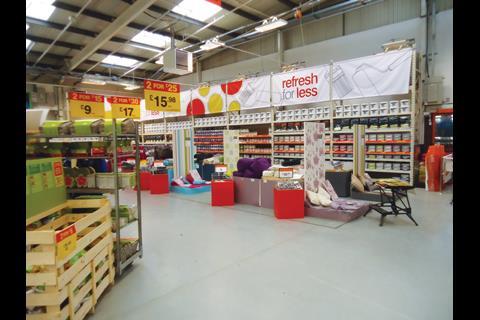
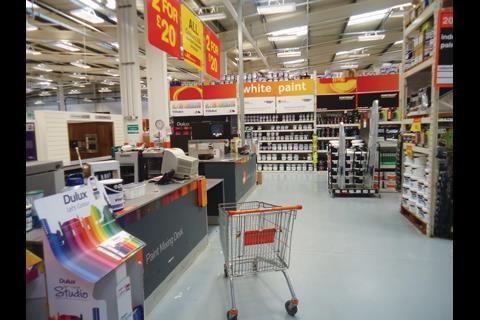
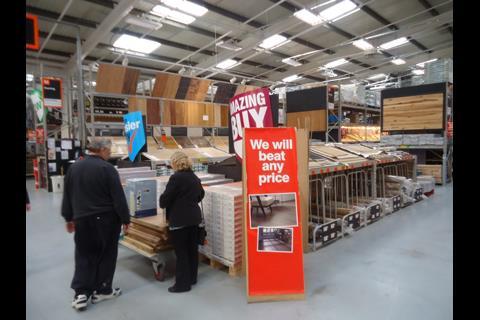
For shoppers, this equates, all too frequently, to stores that you enter and, in spite of a blizzard of overhead signage, if you can find what you want straightaway, then it may well have been the result of luck, rather than ease of navigation and judgement. And a big part of the problem, according to Steve Delo, director of merchandising and space planning, is the “racking”.
In Havant, racking in this context passes the Ronseal test (and yes, Ronseal products are on display). This store is reasonably typical of a B&Q and much of it is filled with high racks that put “the stock up in the air”, as Delo describes it. He points out that the clue to the issue is in the name and the fact that many branches are B&Q Warehouses is because they are just that – sheds with stock that allowed shoppers to wander around.
Altered image
All that is set to change. A new IT system has been installed that will mean more frequent deliveries, shorter lead times from suppliers and stock that is more readily available. This means the requirement to stack the racks up to the ceiling is obviated and therefore, as Delo observes, things can be reconsidered and altered.
It’s a process that is well under way.
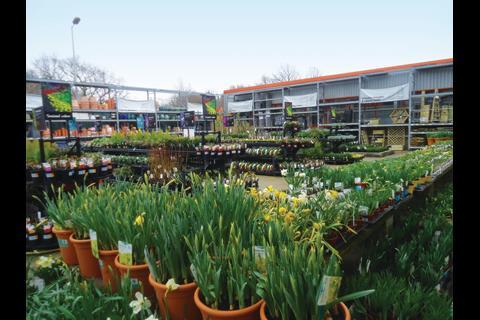
B&Q began changing layout and equipment in its stores in January and it started with the external part of the store – the outdoor gardening department. Walk out of the Havant store’s covered area and into the garden department and it is clear that things have morphed. Everything is lower and you can see from one end to the other of this relatively modest space – it is immediately more navigable.
Also this is just one store out of a 358-strong portfolio and all of the stores’ garden departments have been given the same treatment – since January – by relaying this one area within the stores, 7 million sq ft has been rethought. This would be the equivalent of remodelling a total floorspace that is just shy of that occupied by John Lewis in this country.
Next will be the ‘ceramics’ department. This is B&Q speak for tiles and up until now the modus operandi for displaying this category has been heavy pieces of equipment shaped like a series of pitched roofs, along which samples of the merchandise can be shown.
The new look will involve editing the ranges – with the B&Q brand being the primary consideration – and displaying the outcome on tables that are lightweight, modular and can be installed without recourse to a forklift.
The process will begin in May and, once again, will be taken across the whole of the estate.
It will also be largely “invisible”, according to Delo – which translates as minimising disruption while the changes are effected.
The plan is that all departments will have been refurbished by 2014, at which point the shopper experience will be similar, irrespective of which branch the shopper visits. Perhaps understandably, this is not a cheap project. Delo does not reveal the total spend involved, but says relaying a store the size of Havant would cost “considerably less than £1m”.
This in turn means that with 20 million sq ft still to be restyled, the final cost is likely to be measured at something more than £100m, all of which has been budgeted for.
Shopper essentials
So is this the future for DIY retailing? Given the size of the operation and the fact that B&Q is the market leader, the answer has to be a pretty unequivocal yes and when everything is done, the stores will be easier places to shop. Delo’s statement that elements of the stores as they stand are “massively out of date”
underpins the move, but the result will be, from small to large, ‘A’, ‘B’, and ‘C’ category stores that will make shopping for DIY essentials better all round.
About an hour away along the A3, the New Malden store – the two-floor behemoth that opened in 2009 – will also be the recipient of a makeover, in spite of being much newer
than Havant. There’s only one mild quibble about it – driving past, it doesn’t seem to have managed to get the wind turbine that tops the tower adjoining the store to turn other than sporadically. There is probably a perfectly good reason for this, but it does seem hard to fathom. Some things really are tough to change.
The B&Q estate

Total estate area
27 million sq ft
Number of stores 358
Project started January 2012
Anticipated completion date 2014
Director of merchandising and space planning Steve Delo

No comments yet