













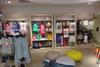
It is more than a year since Tesco opened its first F&F standalone store in Prague. Now the brand is spreading its wings with its largest outlet to date, in Brno.

Brno? Yes, Brno. It is a name few in the UK will be familiar with and yet this is the Czech Republic’s second city, the administrative capital of south Moravia (a region in the south central part of the country) and is not far from Vienna. It also happens to be the site of Tesco’s second F&F standalone store, which opened at the end of last year and which is now the blueprint for the format on a larger scale as the retailer begins rolling it out internationally.

At this point, it is worth noting that there has been an F&F standalone store in Prague for more than 18 months and it is only now that Tesco’s central Europe powers have seen fit to begin rolling things out. And although it is similar to what could be seen in Prague’s Palladium shopping centre, the format has moved on and now includes kidswear as part of the mix.

This branch is actually in an edge-of-city mall, rather than a city-centre location. The mall, dubbed Olympia, is enormous, with seemingly every major European fashion retailer from Marks & Spencer to H&M having some kind of representation within its precincts. Indeed, the site now occupied by F&F was an H&M until 2011.

Since the end of last year, however, it has been a fully functioning F&F standalone. Measuring a little more than 10,000 sq ft, it is a store of several parts with four discrete yet connected spaces, each housing a different department.

The exterior, however, is the thing that works overtime to get shoppers into the space. Both of the ‘F’s in F&F are, in effect, outsized lightboxes that grab the gaze. The ampersand connecting them is a variant on the Prague store with the backing to it being silver. These represent a sufficiently loud shout, but the windows are not overshadowed – large coloured letters announce ‘summer’, although why this is not in Czech is a minor question.

The interesting part in this is that the clothing, as displayed on a bevy of T-shirted and bikini-topped male and female mannequins, almost plays second fiddle to the window message. There is, however, little mistaking this for anything other than a young fashion store.

Heading indoors, the equipment, which looks as if it floats, was originally designed by consultancy Four IV for the Prague prototype and is still in place. But new additions, ranging from a zigzag display unit to a table supported by slanted Fs that act as legs, are a change from the original and show how this is a format that is still developing.

Paul Andrews, creative visual manager for Tesco F&F standalones, says owing to the considerably extended footprint when compared with the Prague store there is “a real sense of space”. He adds: “When you look across the floor, there are some pause points and the footwear and accessories area and kidswear are both new.”

Influential environment

The similarities are probably greater than the differences, however, until you reach the kidswear department at the back of the shop. Andrews observes that 70% of the ranges are the same as those on offer in Tesco’s Czech hypermarkets. The difference is that you would never be aware of this and it shows the power of an environment to influence the way in which stock and merchandise stories are viewed.

For the new kidswear area, accessed by a corridor that in its H&M life led to a non-selling area, this means a shop-within-a-shop featuring a starburst neon light feature that sits within a circular recess in the ceiling, which is “standard for all of our stores going forward”, says Andrews. And in place of the black mid-shop and perimeter equipment used in the rest of the store, this space is all white. Like the rest of the shop, however, care has been taken with the F&F branding, with the fitting rooms having Damien Hirst-esque dot print wallpaper and F-shaped handles on the doors.

Andrews says that as well as the interior and exterior design of this store being different from the experience of visiting a local Tesco hypermarket, the staff are different as well. “We do try and make our standalone stores different from the rest of what we do and so we recruit people with specialist knowledge,” he says.

As an exercise in building a new format there is a strong streak of pragmatism about what Andrews and his team have done. “What’s our style? What’s our tone of voice and how are we going to merchandise?” he asks, talking about the development process.

First in Poland

At the time of writing, the first F&F standalone had recently opened in the Polish capital Warsaw and representatives from the retailer’s Korean arm had just descended on the store bearing tape measures – a possible precursor to the format making its Far Eastern debut. Certainly, this is a move on from what was done 155 miles to the north in Prague and it now looks a thoroughly portable proposition.

And, interestingly, F&F stores now come in three sizes – a small, medium and large-sized footprint, which mirrors the three stores currently up and running. On the question of why F&F standalones are not destined to make an appearance any time soon in the UK, the reason given is that the competitive environment is much fiercer in the young fashion arena than it is in Eastern Europe. That said, with all the branded Western European suspects evident in the enormous Olympia mall, it is hard to see how this is different from anywhere else.

Tesco continues to work with F&F and the results at the moment look positive. Perhaps it might be time to reconsider if what seems to be a blanket ban on it making an appearance in the home country is such a great idea.