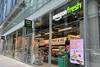












The closure this week of Amazon’s debut Fresh store in the UK has once again raised questions about the headway the giant is making – or can make – in food, a prize retail market because of its size and importance.

When Amazon Fresh touched down in the UK in 2021 with its first opening in Ealing, west London, it made a big splash with its checkout-free, cashless model that enabled customers to ‘just walk out’ by scanning their smartphones.

Only two years later, that Ealing branch of Amazon Fresh, along with two others in southwest London, have closed their doors – a seeming setback for the retail giant’s grocery ambitions. But is it really?

Amazon still has 17 Fresh stores in the capital. Who knows how many of them will last, but the retailer has indicated it remains committed to the format. It said this week: “While we decided to close three Amazon Fresh stores, it doesn’t mean we won’t grow – this year, we will open new Amazon Fresh stores to better serve customers in the greater London area.”

The experiment, even if ultimately unsuccessful, is testament to Amazon’s willingness to push the boundaries and try new ideas. That should be applauded. Cash handling is extremely costly for retailers, particularly high-turnover stores such as convenience shops, so for that reason alone it was worth trying out.

That said, it is unclear what makes the Fresh format distinctive other than its deployment of technology. And although tech innovation may be exciting for Amazon and other retailers, when it’s customer facing it needs to work for the shopper too.

“Although tech innovation may be exciting for Amazon and other retailers, when it’s customer facing it needs to work for the shopper too”

In that vital respect it was of limited appeal to shoppers who had to use the Amazon app and scan QR codes – more than one if shopping with family or friends.

Hardly frictionless and it excluded passing trade – important in the convenience market – with would-be customers needing to go through the rigmarole of signing up just to pop a sarnie and a bottle of water in their baskets.

There were also questions about some of the locations – perhaps revealing Amazon’s relative weakness in some traditional retail disciplines – and concerns about privacy. Sainsbury’s and Tesco, which have also tried out cashless stores, also came up against shopper resistance.

For those sorts of reasons, Fresh has struggled in the all-important quest to make money. Earlier this year Amazon boss Andy Jassy said the Fresh estate would not be significantly expanded “until we have that equation with differentiation and economic value that we like”.

However, the Fresh closures and the headlines they have generated obscure the fact that Amazon is not in the position of knocking on grocery’s door – it’s increasingly an established player.

“The Fresh closures and the headlines they have generated obscure the fact that Amazon is not in the position of knocking on grocery’s door – it’s increasingly an established player”

It has partnerships with incumbents such as Morrisons and last year its food operations fell under the remit of the Groceries Supply Code of Practice. The code applies to grocers generating sales in excess of £1bn – powerful evidence of the scale in food that the Seattle Goliath has built up.

The big question is why Amazon has not bought a UK grocer, despite repeated speculation that it would; Morrisons and more recently Ocado have both been seen as potential targets.

Such a deal would follow Amazon’s landmark acquisition of Whole Foods in the US and the appointment of Tesco veteran Tony Hoggett to run it and other physical stores.

The benefit of such a deal would be to give Amazon access to the UK supply chain, which the established grocers use skilfully to ensure shelves are full of seasonal and weather-driven produce such as strawberries in the summer (although perhaps not this wet summer).

Wherever Amazon ends up devoting its energies, food is still firmly on its agenda, as are stores because bricks and mortar accounts for the majority of food retail sales.

Expect Amazon to look for fresh ways of increasing its market presence, even if Fresh is not the breakthrough venture in the category.

Want more exclusive insights on the realities of working on the frontline of UK retail? Access your free copy of Talking Shop: What 530 store staff really think of your strategy today.

Talking Shop report

In Retail Week’s unmissable report, you will discover:

  • Which sectors’ workforce feel hardest hit in terms of job security

  • How retailers such as Ikea, Holland & Barrett and M&S are taking action to support store colleagues

  • Where you should invest in your teams and which areas of retail will be most improved with innovative tech

  • Frontline colleagues’ forecast for the shape of the stores of tomorrow